In automated fixtures or integrated test benches for wire harness testing (continuity, insulation resistance, and airtightness tests), non-standard cylinders—including custom-stroke models, irregularly shaped mounting types, finger cylinders, and slim clamping cylinders—are primarily used to replace manual operations, enabling rapid positioning, clamping, probe alignment, and error-proof locking of wire harnesses. Specific application scenarios are as follows:
Terminal/Connector Clamping—Ensuring Reliable Probe Contact
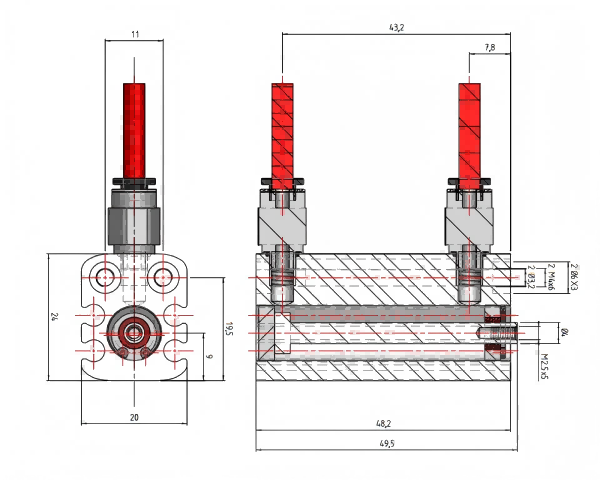
This is the most common application. After placing the connectors or terminals at both ends of the wire harness into contoured locating grooves, a slim clamping cylinder (with custom-designed clamping blocks) descends to securely clamp the connector, ensuring stable contact between the rear-end test probes or spring pins and the terminals. This prevents false connections that could lead to incorrect continuity or insulation resistance test results.
Customization points: The clamping block shape is machined to match the connector profile; cylinder stroke and mounting height are adjusted according to wire harness thickness.
2. Test Fixture Mold Closing—Automatic Probe Array Alignment
On automated test benches, dual-axis or multi-axis non-standard cylinders drive an upper test fixture (equipped with multiple probe arrays) vertically downward, aligning it precisely with a lower test fixture where the wire harness is already positioned, enabling simultaneous multi-point continuity or high-voltage testing.
Customization points: Cylinders require guide rods to prevent rotation and built-in cushioning; template spacing can be customized based on wire harness height.
3. Multi-Branch Wire Harness Positioning and Clamping—Preventing Displacement or Entanglement
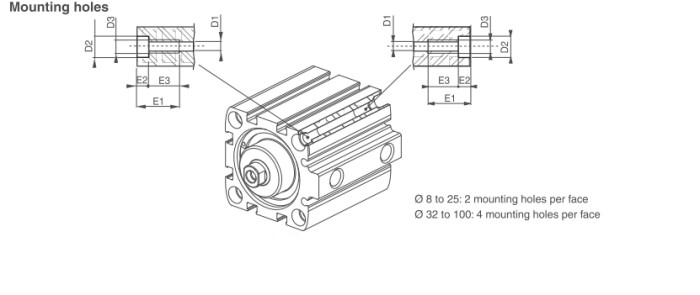
Automotive wire harnesses often feature Y-shaped or multi-branch configurations. Before testing, parallel finger cylinders (customized gripping fingers) or side-clamping cylinders position and clamp each branch within designated routing channels, ensuring stability during testing without shifting or crossing, thus providing a consistent reference for subsequent pin insertion or probe inspection.
4. Floating Engagement and Locking for Non-Probe Interfaces
For interfaces such as Type-C, USB, or HDMI that cannot accommodate direct probe insertion, a non-standard cylinder equipped with a floating mechanism gently inserts the test head into the interface. Upon proper engagement, a contact ball or push pin locks the connection in place before initiating continuity testing, preventing damage from forceful insertion.
5. Error Prevention and Automatic Release—Sorting Good vs. Defective Units
After testing, a release cylinder automatically unlocks all modules with one press, allowing easy removal of qualified products. Defective units remain locked by an error-proof locking cylinder, triggering an alarm to prevent faulty wire harnesses from proceeding to downstream processes.
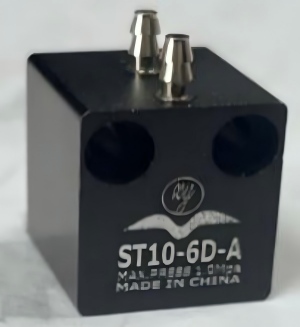
6. Foolproof Clamping for Short and Long Wires
Some test modules incorporate small clamping cylinders beside the routing channel. A short wire harness triggers the clamping block, initiating the continuity test. Long wires, due to bending, fail to trigger the mechanism and instead activate a buzzer alarm, enabling foolproof differentiation and mixed-length testing.
Prev:How to choose suitable harness hanging fixtures and harness forks for harness engineers?
Next:No more