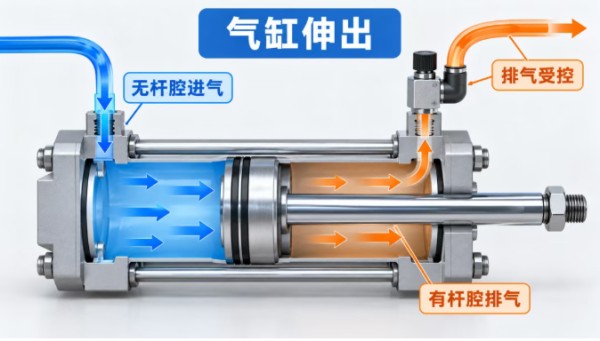
For speed regulation of double?acting pneumatic cylinders, always check exhaust throttling first: keep the intake relatively unobstructed to build controllable back?pressure inside the exhausting chamber.
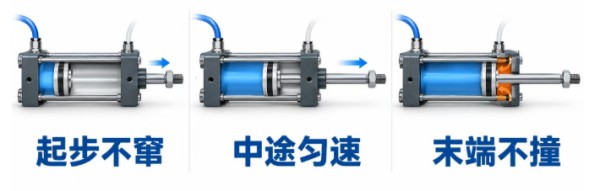
If you only restrict intake air, gas is compressible. Combined with load variation and static friction, the piston may get stuck temporarily and then jerk suddenly.
Exhaust throttling is the common starting?point, yet it is not a universal connection method suitable for every cylinder.
A typical one?way flow?control valve consists of a throttle orifice and a check valve. Air flows freely in one direction, while the reverse direction is restricted by the needle valve.
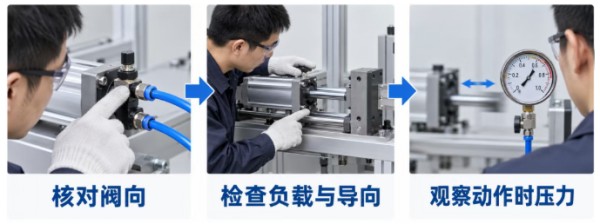
Mounting the valve close to the cylinder port does not guarantee exhaust throttling. You also need to check valve markings, model?specific pneumatic circuit diagrams and the actual airflow direction during operation.
When the cylinder extends, air enters the cap?end chamber and air exhausts from the rod?end chamber. Airflow reverses during retraction. Therefore, inspect the corresponding exhaust path separately for speeds in both directions.
First, lock your working conditions: record the set supply pressure, applied load, stroke time for both extension and retraction, and mark whether abnormalities occur at the start, mid?stroke or end?of?stroke.
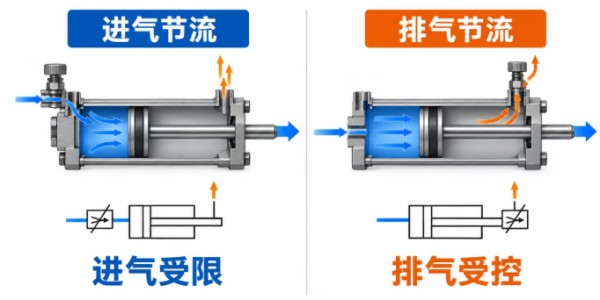
Next verify flow?control valve model and installation orientation. Confirm that exhaust from the faulty stroke indeed passes through the adjustable throttle orifice.
If the valve is fitted backwards, or intake throttling is mistakenly used instead of exhaust throttling, correct the wiring according to the pneumatic drawing for that specific model. Then gradually increase speed starting from low values to your target; do not simply open the needle valve wide for trial runs.
Observe whether the abnormality changes together with the load. If jerking happens whenever load shifts, or crawling appears at low?speed movement, inspect guidance parts and eccentric load, friction inside the cylinder plus external mechanism, and whether supply pressure drops during movement.
Simply turning the adjusting screw on the flow valve cannot resolve mechanical sticking or insufficient air supply.
For vertical axes with notable over?running loads, additionally verify dedicated circuits and anti?drop measures. Do not treat exhaust throttling as a reliable holding device.
If both extension and retraction become slow or speeds drift, inspect the shared air source and exhaust paths. Monitor pressure fluctuation downstream of the filter?regulator during movement. After shutting down and isolating the circuit, inspect filter elements, crushed tubing and whether the silencer at the directional?valve exhaust port is clogged.
If only one?direction movement behaves abnormally, trace along that particular exhaust path and check the flow?control valve, tubing and fittings first.
Troubleshoot after locating the flow?restricting point, then re?measure stroke?time. Do not mask blockages by continuously opening the needle valve further.
Prev:What can POM (Polyoxymethylene) boards be used for?
Next:No more