Considering the strong demand in the automotive industry for safety and multimedia system improvements, wire harness production has become increasingly important. Adapting to the integration of new technologies in vehicles poses a challenge for wire harness manufacturers. Currently, wire harness production still heavily relies on human labor, and the allocation of workload across workstations has a significant impact on productivity. Components such as terminals, connectors, and seals are becoming smaller, making manual handling more difficult. One potential solution is to increase the level of automation in wire harness production.
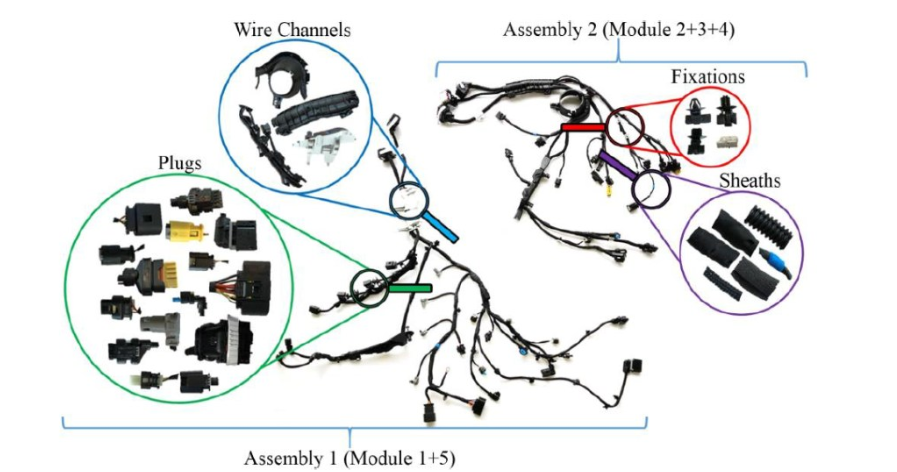
The objective of this study is to identify solutions for optimizing the wiring assembly process through partially automated production workflows. While attention to automated processes in automotive wire harness manufacturing is not new, so far manufacturers have focused more on the prefabrication of individual harness components rather than on the assembly line for complete wire harnesses. From an economic perspective, automation of the assembly process can enhance productivity by reducing manufacturing time and the uncertainties associated with labor dependency.
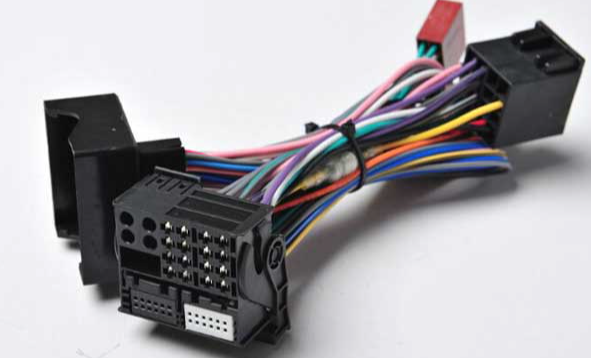
In the automotive industry, a wire harness is a set of components—including wires, terminals, connectors, seals, protective devices, fasteners, cable ties, fuses, relays, and fuse/relay boxes—designed to ensure connectivity among electrical and electronic components integrated into the vehicle.
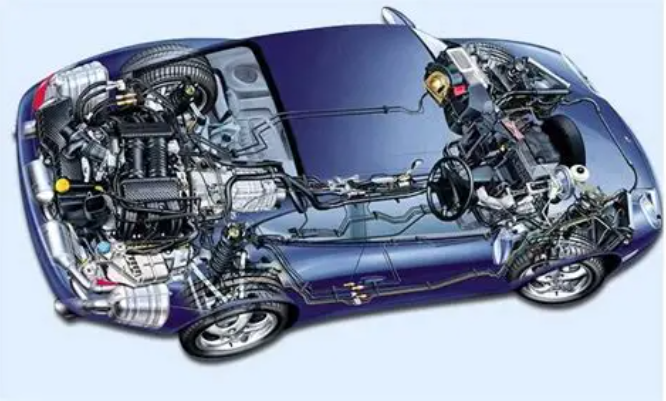
The diversity of wire harnesses has increased in parallel with the development of vehicles’ electrical and electronic functions, new communication technology integration, and control and software applications, becoming a set of options available to vehicle buyers. assembled as part of the harness spans several kilometers. A version of the Mercedes-Benz OM654 engine harness provides a practical example of wire harness complexity, comprising 54 connectors, 116 wires, covering an area of 4 m² when straightened, and weighing 1.5 kg.
Due to the complexity and diversity of wire harnesses, manufacturers have two options:
1. Divide the wiring into smaller modules (if feasible) to be manufactured on dedicated assembly lines for each module, followed by final wiring assembly (either at the same production site or near the automotive manufacturer);
2. Manufacture the final wiring on larger, more complex assembly lines.
Regardless of the approach, module production and final assembly require similar manufacturing and assembly techniques.
Production workflows are organized according to the assembly techniques implemented, typically divided into:
l Dynamic assembly lines: Generally used for manufacturing wire harness modules and smaller harnesses. Several types of dynamic assembly lines have been developed, but the most common for less complex harnesses consists of fixed assembly boards (trays) with a conveyor located beneath the wires to carry the harness from one workstation to the next. Components for assembly are provided on the front side to ensure ergonomic conditions for operators.
l Turntable assembly lines (also called rotary tables): Used for manufacturing large modules and for final module assembly. Turntables consist of several plates mounted on a track, allowing rotation. This production technique typically decomposes all work into a few basic tasks. Each operator performs a limited number of assigned operations on the rotating/moving turntable, which are always the same. The assembly line speed is designed to ensure productivity and quality standards.
Whether manufacturers choose to use dynamic assembly lines (LAD) or turntable assembly lines, both require workstations and equipment to produce prefabricated components that form part of the final harness.
Automating assembly workflows is challenging for wire harness manufacturers. Automated wire harness assembly systems must be highly flexible and easily adaptable to meet the diverse and dynamic requirements that arise at different project stages.
Challenges in automated wire harness assembly processes include:
l Handling difficulty, as wires in a harness are highly flexible and often long;
l Variety of components in the final harness, including wires of different lengths and diameters, terminals, seals, connectors, protective devices, and fasteners;
l Multiple operations required to ensure connectivity: simple crimping (manual or automated), double-wire crimping (manual or automated), ultrasonic welding, twisting, inserting terminal-wire assemblies into connectors, and applying protection;
l Diversity of harnesses produced in a project, often requiring different assembly boards (trays);
l Wiring architecture changes during project development, involving rapid modification/adjustment of the operation sequence and assembly system;
l Changes resulting from after-sales quality events, which, although smaller than during development, also require rapid adaptation of the wiring system.
Prev:Principle and Description of Wire Harness Testers and European Continuity Testers